On June 20, the EU’s legislative committee will vote on the new Copyright directive,
and decide whether it will include the controversial “Article 13”
(automated censorship of anything an algorithm identifies as a copyright
violation) and “Article 11” (no linking to news stories without paid
permission from the site).
These proposals will make starting new internet companies effectively
impossible – Google, Facebook, Twitter, Apple, and the other US giants
will be able to negotiate favourable rates and build out the
infrastructure to comply with these proposals, but no one else will. The
EU’s regional tech success stories – say Seznam.cz,
a successful Czech search competitor to Google – don’t have
$60-100,000,000 lying around to build out their filters, and lack the
leverage to extract favorable linking licenses from news sites.
If Articles 11 and 13 pass, American companies will be in charge of
Europe’s conversations, deciding which photos and tweets and videos can
be seen by the public, and who may speak.
The MEP Julia Reda has written up the state of play
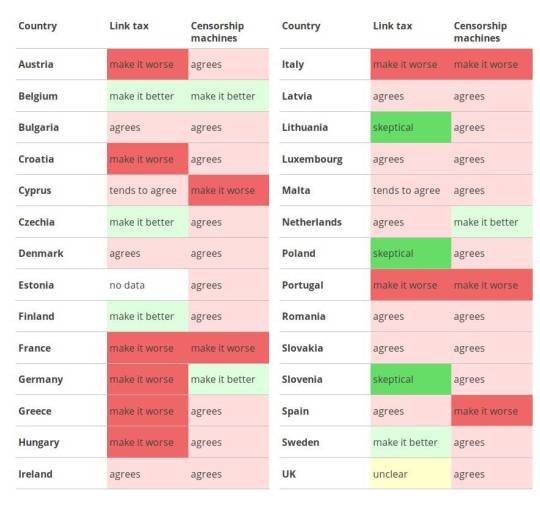
on the vote, and it’s very bad. Both left- and right-wing parties have
backed this proposal, including (incredibly) the French Front National,
whose Youtube channel was just deleted by a copyright filter of the sort they’re about to vote to universalise.
So far, the focus in the debate has been on the intended consequences of
the proposals: the idea that a certain amount of free expression and
competition must be sacrificed to enable rightsholders to force Google
and Facebook to share their profits.
But the unintended – and utterly foreseeable – consequences are even
more important. Article 11’s link tax allows news sites to decide who
gets to link to them, meaning that they can exclude their critics. With
election cycles dominated by hoaxes and fake news, the right of a news
publisher to decide who gets to criticise it is carte blanche to lie and
spin.
Article 13’s copyright filters are even more vulnerable to attack: the proposals contain no penalties for false claims of copyright ownership, but they do
mandate that the filters must accept copyright claims in bulk, allowing
rightsholders to upload millions of works at once in order to claim
their copyright and prevent anyone from posting them.
That opens the doors to all kinds of attacks. The obvious one is that
trolls might sow mischief by uploading millions of works they don’t hold
the copyright to, in order to prevent others from quoting them: the
works of Shakespeare, say, or everything ever posted to Wikipedia, or my
novels, or your family photos.
More insidious is the possibility of targeted strikes during crisis:
stock-market manipulators could use bots to claim copyright over news
about a company, suppressing its sharing on social media; political
actors could suppress key articles during referendums or elections;
corrupt governments could use arms-length trolls to falsely claim
ownership of footage of human rights abuses.
It’s asymmetric warfare: falsely claiming a copyright will be easy
(because the rightsholders who want this system will not tolerate
jumping through hoops to make their claims) and instant (because
rightsholders won’t tolerate delays when their new releases are being
shared online at their moment of peak popularity). Removing a false
claim of copyright will require that a human at an internet giant looks
at it, sleuths out the truth of the ownership of the work, and adjusts
the database – for millions of works at once. Bots will be able to
pollute the copyright databases much faster than humans could possibly
clear it.
I spoke with Wired UK’s KG Orphanides about this, and their excellent article
on the proposal is the best explanation I’ve seen of the uses of these
copyright filters to create unstoppable disinformation campaigns.
There’s pretty detailed information about the law from the above-mentioned Julia Reda here.
This site gives info on the 10 remaining ‘undecided’ MEPs, and contact information. (Oddly, it seems to be a different list from this other set of undecided MEPs on the committee.) I don’t get the impression any MEPs outside the Legal Affairs committee have any influence at this point in the legal process.
There’s a gadget on this page that will apparently identify your MEP and set up a call between your phone number and them.
I admit I’m not sure what I can say that would make the Conservative MEP ‘representing’ me prioritise things like artistic expression and access over the wealth of giant tech and media companies, but I can try.


 Backup Tumblr Blog